Login
Register


Sponsored
A major question for the industry as it looks towards giving interconnected AI agents autonomy to act in the network is how to ensure they have the right level of knowledge to inform decisions.
 Joanne Taaffe
Sponsored by:

Telstra and Ericsson turn information into knowledge to deliver on the customer’s intent
Since Einstein’s day, organizations have made huge progress in turning data into information, and embedding it in operational processes and business software systems. Strictly speaking, data represent facts that require structure and analysis to become information.
Knowledge, however, still remains a typically human sum of experience, context and insight that can be used to evaluate, analyze and act on information.
The question for telcos as they think about giving more autonomy to interconnected AI agents to perform actions on their networks is how to give them the context and insight – the knowledge – they need to safely find solutions and recommend actions.
And it is a question Telstra and Ericsson tackle in their co-authored paper, entitled Industry perspective: From automation to autonomy.
The issue is becoming more pressing as communications service providers (CSPs) weigh both how to deliver on the customer’s intent and how to achieve TM Forum’s Level 4 of Autonomous Networks (ANs).
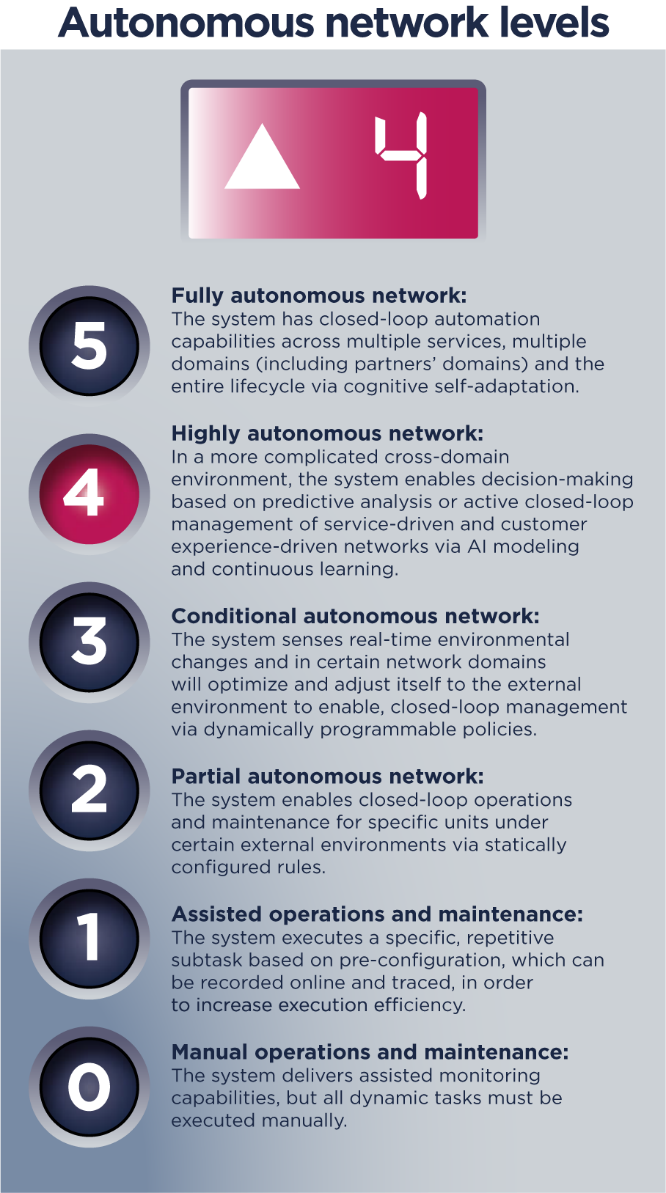
Decision-making in Level 4 ANs is based on predictive analysis or active closed-loop management of service-driven and customer experience-driven networks via AI modelling and continuous learning. It therefore represents a significant shift in how telcos have traditionally approached automation, which typically involves human engineers writing scripts and triggering actions within pre-defined conditions.
Highly autonomous networks will rely on AI/ML agents. To act effectively, these agents need rich, real-time context at the point of execution to understand intent, state, dependencies, and risk, so they can choose the best action for service outcomes—while also complying with regulatory, security, and customer privacy requirements.
AI agents will also have to coordinate their efforts across the full complexity of a CSP’s network domains and systems if they are to avoid building pockets of autonomous operations, which can result in siloed decision-making, unreliable handoff, and cross-domain failures that undermine end-to-end autonomy.
For this to work, agents operating across heterogeneous systems will need to share a common understanding of services, customers and policies as well as knowledge of why events such as network faults happen.
Just as importantly CSPs will need to understand how agents use knowledge so that they can audit their decisions with respect to, say, regulatory or cost demands.
This need to build and structure knowledge is one of the reasons the word “ontology” features more regularly in conversations about autonomous networks.
Telstra’s Chief Architect, Mark Sanders, says he would like to see the industry “move forward with a shared language, an ontology of how we can model knowledge for a telco business … so we can improve on the reasoning that we’re doing,” within a given context.
In the context of an autonomous network, an ontology is the shared semantic model that defines the key network, service, customer, operational and business concepts, and the relationships between them, in a way that both humans and AI agents can understand and reason over consistently, explains Sanders. It provides the common language and meaning layer that connects data, intent, policy, topology, inventory, assurance, orchestration and operational knowledge across domains. This allows autonomous agents to move beyond interpreting isolated data points and instead understand context, dependencies, constraints and outcomes, enabling more reliable reasoning, decision-making, automation and closed-loop action across the network.
When it comes to the network, “the knowledge needs to be semantically rich”, according to Sanders. “It needs to not just be knowledge around the topology of the network. It needs to have business processes coded in our engineering design limits, our policies and even regulatory frameworks,” he explains.
“That knowledge needs to be encoded in a way that is not just declared, but also inferred and learnt over time, combining what we explicitly design into the network with what the system can understand and discover for itself,” says Sanders.“No single domain will be an expert on every other domain. So, you have to start creating this kind of unified understanding again. That’s the work we see with the knowledge plane, [and] when you can connect those dots, so to speak, it is very, very powerful,” Jason Keane, Head of Business and Operations Support Systems Portfolio, Ericsson, said during a recent TM Forum webinar.
Telstra is a leader when it comes to modelling relationships between network components and encoding knowledge, which has included work on ontologies. In 2024, for example the operator won a TM Forum Excellence award for its “Knowledge Plane”.
Rather than having network engineers encode individual use cases into automation scripts, Telstra is embedding knowledge about network domains, resource behaviour and operational context into the Knowledge Plane, according to Sanders. Instead of pre-coding every scenario, fault and response, engineers declare engineering rules, policies and design constraints, while continuously tuning the models that interpret, infer and learn from that knowledge. The network moves from being explicitly programmed for every outcome to one that can reason, adapt and improve over time. This shift removes the need for low-level control logic and allows engineers to focus on higher-value work, such as optimising outcomes, shaping system behaviour and creating new services and innovations that were previously impractical to design or operate at scale.
Crucially, the knowledge plane enables engineers to think in terms of outcomes, or intents, instead of step-by-step processes. An example of how Telstra is already delivering outcomes is Adaptive Networks, which launched commercially in June 2025 for enterprise customers. These solutions expose network connectivity so that enterprises can use it with the same ease and scalability as they do storage and cloud compute provided by hyperscalers.
Ontology is a core element of the knowledge plane, and Telstra created its ontology using the TM Forum Information Framework.
Telstra’s work in this area continues to evolve, as does the operator’s collaboration with the wider industry, including with Ericsson.
Knowledge plane is a key strategic area for Telstra’s and Ericsson’s joint work to accelerate the shift towards autonomous networks. Together they are defining the blueprint for a knowledge plane (an information layer using data, AI, and reasoning to monitor, analyze, and control the network intelligently) that can act effectively as the foundation of autonomous networks.
“We think it’s ... really important part to move from data to knowledge and then use it for many, many benefits to our business, including service orchestration,” said Sanders, when referring to Telstra’s collaboration with Ericsson during the webinar.
Ericsson and Telstra have also been working together with other TM Forum members within a TM Forum Moonshot Catalyst project called Conflict management in intent-based networks - Phase II. The Catalyst is exploring the role of Knowledge Plane in resolving conflict at different levels. as Vivek Jain, Strategic Product Manager, Data Analytics & AI, Ericsson, explains.
In telecoms networks, intent is the foundation that guides how agentic AI understands and acts on users’ objectives. Rather than carrying out predefined instructions, agents seek to infer the desired outcome and then autonomously coordinate actions across multiple systems and domains to achieve that goal. CSPs can use ontologies to translate and understand intents and ensure a common understanding of intent across systems, thereby helping to resolve conflicts between overlapping goals.
The knowledge plane stores ontologies, constraints, rules and policies which different systems can draw on to enable consistent reasoning and safe, cross-domain decisions, according to Jain.
He gives the example of how a knowledge plane can manage the conflicting intents of a broadcaster and a provider of emergency services using the same 5G network during a stadium event. If the broadcaster requests greater uplink speed, but the emergency service has priority access to network resources, then the telco will have to resolve the conflict to fulfill the broadcaster’s request.
The broadcaster can use an intent utility function to signal whether it is willing to accept changes to its broadcast quality
“The knowledge plane uses the information that the broadcaster is flexible about reducing the broadcast quality from 4K to HD to generate alternative recommendations via the intent utility function,” Jain explains.
He emphasizes that the knowledge plane does not take action. Instead, it provides knowledge to an orchestrator, an assurance system, or a proposal agent, for example, so as to evaluate options, choose a safe plan, and execute the appropriate changes.’
Ultimately, the aim is to “drive more knowledge out of the data and store that knowledge so that agents can query it and make smarter decisions/actions. ,” says Jain. “As … we move towards more agentic AI use cases and AI frameworks, having a knowledge plane with interconnected dependencies will surely enhance the AI agents.”
Keen to see industry-wide standardization around ontologies, Telstra’s Sanders believes TM Forum is well placed to help develop shared ontologies that help agents use knowledge.
“TM Forum, ODA, TRAM [Telstra’s reference architecture model, based on ODA] – it is all about bounded contexts of technology … and using APIs to abstract components,” says Sanders. “We want to make sure we adhere to those principles. So, I think the first starting point is to leverage that foundation … and that framework.