Member Insights
Scaling autonomous networks at DTW Ignite: Vision to implementation
Google’s Jen Hawes-Hewitt reflects on DTW Ignite 2026 and the transition from siloed automation to truly agentic networks.
 Jen Hawes-Hewitt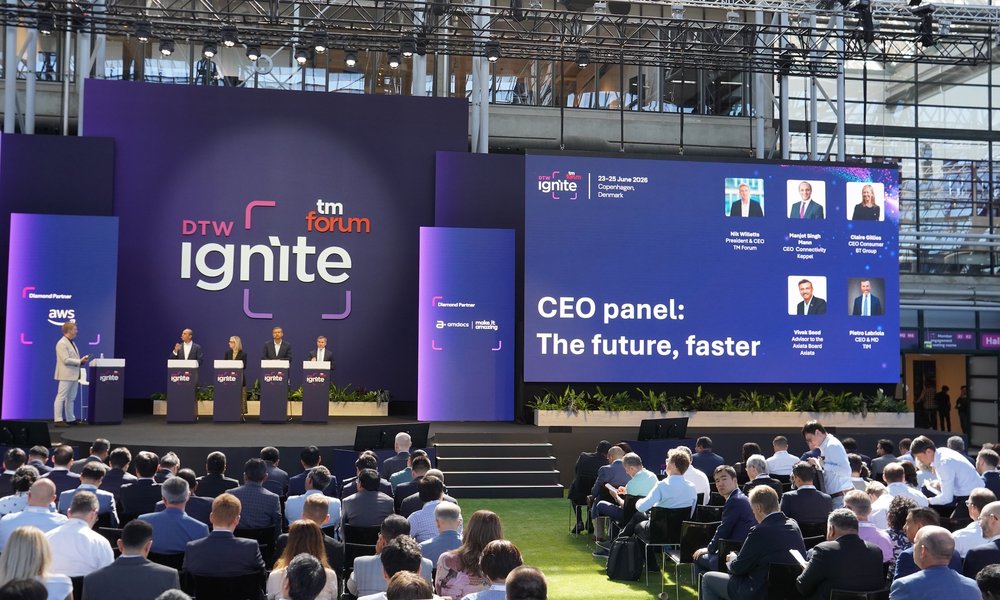
Scaling autonomous networks at DTW Ignite: Vision to implementation
Last year’s DTW Ignite was about articulating the vision for the autonomous network. This year revealed a distinct shift in focus from vision to implementation, as we saw a series of Tier 1 operators and their partners take center stage to showcase how we are embedding AI into the heart of operations to drive real-world outcomes. By shifting from networks that merely use AI for insights to intelligent agents capable of sensing, reasoning and taking autonomous action, we are turning connectivity into a value-creating engine.
Following are some key observations from an exhilarating few days.
Ecosystem momentum: Operators in action
A vibrant ecosystem is essential to achieving Level 4+ network autonomy. At DTW Ignite, the community celebrated several milestones, as Tier 1 operators demonstrated they are invested in accelerating their journey to Level 4+ and transforming operations:
- Verizon’s autonomous networks leadership – In a joint AN Leadership Summit Presentation and conversation with TM Forum CEO Nik Willetts, Verizon and Google Cloud shared insights on how they reframed their network transformation to put customer experience at the center, centralizing huge amounts of data across radio access, transport and core networks onto Google Cloud and building the industry’s first ever temporal digital twin, leveraging Graph Neural Networks to enhance user experiences across the network and reduce customer churn.
- Vodafone’s self-optimizing autonomous networks guide – Vodafone and Google Cloud in collaboration with TM Forum, unveiled the Self-Optimizing Networks Implementation Guide, a deep dive into the technical architectures required to reach advanced levels of autonomy. The paper, with foreword provided by TM Forum CTO George Glass, explores the critical intersection of localized automation and cross-domain intelligent reasoning, demonstrating how AI agents and domain-specific automation work in tandem to build a cohesive autonomous ecosystem. Our goal is to provide a pragmatic roadmap that helps the industry bridge the gap between strategic vision and operational reality.
- Award-winning autonomous networks moonshot catalyst – Verizon, Vodafone, Telefónica, Ericsson, Makman Technology Consulting and Tech Mahindra showcased a groundbreaking Business-Aware GNN Healing Networks Catalyst. Operating on a temporal digital twin, this closed-loop solution uses graph neural networks (GNN) and multi-agent systems to autonomously prioritize network remediation based on real-time financial and business impact, rather than just technical blast radius. By proactively identifying silent degradations, the project successfully demonstrated a 95% reduction in triage time and an 80% decrease in labor costs, potentially saving operators tens of millions in annual opex. Consequently, the team was awarded the prestigious Moonshot Award for Showcase and Storytelling Excellence (read the TechM press release for more details).
Solution updates: Accelerating time-to-value
One of the biggest hurdles to autonomy is bridging disconnected systems and putting in place scalable foundations. During DTW Ignite the community came together to refine their design principles for scaled production:
● Agent Security Framework – Embedding privacy, explainability and compliance into the architecture is a critical accelerator to scalable, ethical AI execution across telecommunications. A key discussion point within the community was ensuring secure foundations for autonomous network operations. Here the TM Forum Data and AI Mission and the AI-Native Blueprint Project are helping provide practical guidelines for ensuring trustworthy agents, providing lifecycle management and ethical guardrails for AI systems, which are vital for CSPs’ readiness to move beyond pilot programs and deploy at scale within mission-critical infrastructure.
● Working in tandem – The shift to autonomous networks is not for a single organization to own; it is a collective effort of the ecosystem rowing in a common direction. As agent-driven functionalities emerge – whether through internal operator development or via network equipment provider solutions – the imperative for effortless interoperability is increasingly vital. At this year’s event, we announced an extended partnership with Nokia, where we are embedding Google’s most advanced multi-modal Gemini models into Nokia’s Autonomous Network product suite, launching an initial catalog of six agents, to help operators reduce complexity and resolve network issues faster. Complex network issues, such as voice degradation, that historically ran for hours, can now be flagged and resolved in minutes, significantly reducing service downtime.
Looking ahead
The transition from strategic vision to tangible implementation at DTW Ignite 2026 marks a definitive turning point for the telecommunications ecosystem. As Tier 1 operators actively embrace agentic AI, the collective path toward achieving Level 4+ network autonomy is rapidly accelerating. By shifting operations from localized insights to cross-domain, closed-loop intelligent reasoning, communications service providers (CSPs) can successfully optimize complex infrastructures while driving significant real-world financial value. Google Cloud is dedicated to co-innovating alongside TM Forum and our global partners, ensuring the secure, robust, ethical, and interoperable foundations required to scale these advanced AI-native solutions and fundamentally redefine future business models.