How telcos worldwide are implementing AN
Results of a survey of 125 individuals at 80 companies worldwide reveals how, where and why and telcos worldwide are implementing autonomous networks, as well as the challenges they face.
 Dawn Bushaus
 Richard Webb
How telcos worldwide are implementing AN
Progress and timeframes for deploying autonomous networks AN differ greatly among CSPs, as do the challenges they are experiencing and how they assess AN outcomes. During research for our latest AN Benchmark report we surveyed 125 individuals at 80 companies worldwide to capture how and why telcos are around the world are implementing autonomous networks. Below we share some of the key findings of the survey in an excerpt from the report.
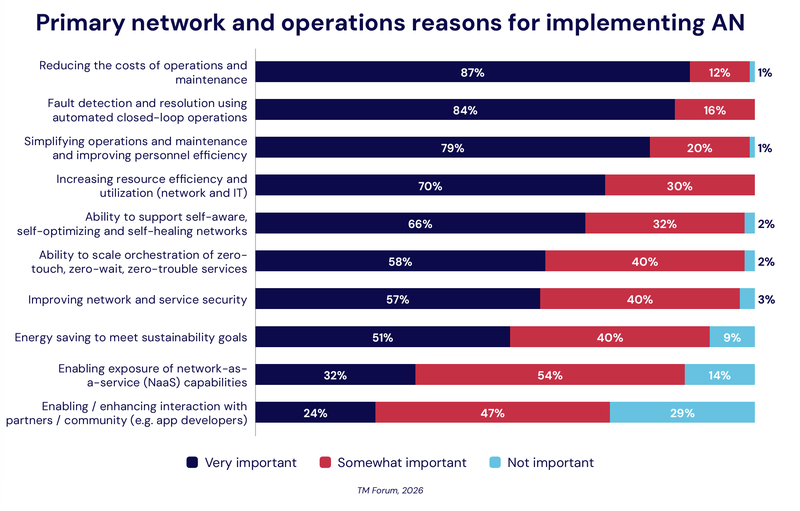
Autonomous networks represent a transformative change in how networks operate, adapt and serve CSPs and their customers. As such, the potential drivers for AN are manifold. We asked respondents to indicate their company’s primary network operations and maintenance-related reasons for advancing AN capabilities.
We gave them a series of options and asked whether they are very important, somewhat important or not important at all. The top options were reducing the cost of O&M, fault detection and resolution using automated closed-loop operations, and simplifying O&M and improving personnel efficiency.
Given that most CSPs face significant challenges to growing revenues, reducing cost is an essential element to maintaining profitability, with savings often enabling further AN investment. Automated fault detection and resolution is the next highest priority, with CSPs keen to reduce the time-consuming nature of fault identification and negative impact of network faults on customer experience.
These both also relate to the next most highly rated reason for implementing AN: reducing O&M complexity and improving personnel efficiency. In other words, simplifying O&M processes reduces task volume and time to complete, saving work hours and potentially employee costs.
On the operations side, AN can help optimize resource management through autonomous processes, managing network complexity and enabling CSPs to greatly reduce manual interventions and operational costs. The overwhelming majority of outages in networks today are due to human error during change management. By using automation there is an opportunity to eliminate many of these errors. With high enough levels of automation, some CSPs estimate they can resolve 95% of trouble tickets without human intervention, in turn greatly reducing the cost of O&M.
China Mobile, for example, already cites a more than 30% reduction in backend O&M man-power, as well as a 30% reduction in fault and customer complaint mean time to repair (MTTR) on average, by reaching Level 4 in its network operations centers.
Of the reasons less strongly rated by respondents as AN drivers, enabling network-as-a-service (NaaS) capabilities is likely to become more important to CSPs, but many are not currently positioned to take advantage of this level of network service sophistication. A fully realized vision of zero-touch, zero-wait and zero-trouble operations remains out of reach for most operators because achieving it requires fully integrated data, mature AI models, seamless cross-domain orchestration and a willingness to hand real-time control to automated systems – all of which are part of CSPs’ ongoing transformation programs. TM Forum’s AN Project advocates network abstraction via NaaS, and the use of business, service and resource intents to facilitate end-to-end, cross-domain management. But this type of transformation is a huge shift for most telcos, and it takes time as well as new approaches to software processes.
Improving security, seen as very important by 57% and somewhat important by another 40%, could rise in the future as AI moves deeper into the heart of the network and CSPs more widely use Model Context Protocol (MCP) and Agent2Agent (A2A) protocol, increasing security risks.
Focusing on customers
In addition to ‘inward-facing’ O&M drivers, AN can potentially deliver more ‘outward-facing’ commercial benefits. AN, based on an intent-driven architecture, enables CSPs to meet expectations for reliable, seamless connectivity and personalized services, by proactively managing network quality and delivering service level guarantees.
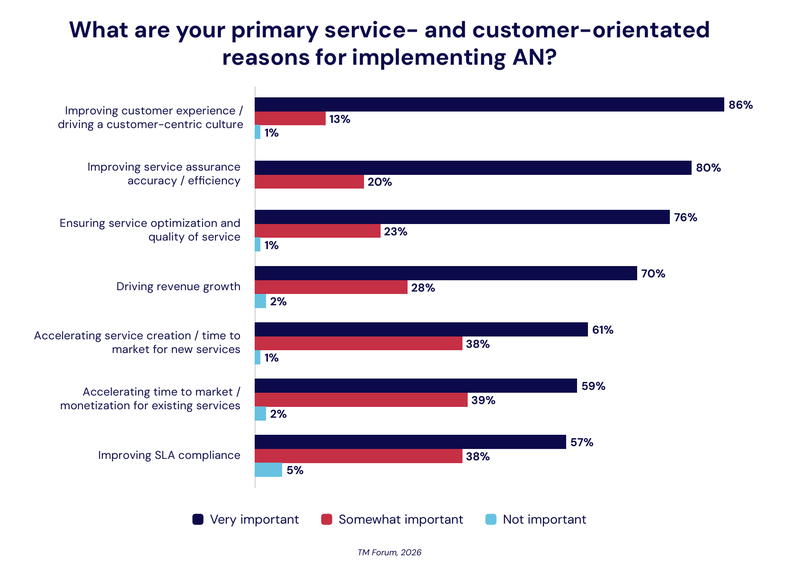
We asked respondents about primary service- and customer-orientated reasons for implementing autonomous networks. The highest percentage of responses was for improving customer experience and driving a customer-centric culture, rated as very important by 86% of respondents.
“Use cases need to be built from the bottom up,” Luthfi Auzan, VP of Operations Transformation & Analytics at IOH, told us, with the focus always on reducing negative impact on the customer. “CX has been at the heart of merger planning and execution of [our] new processes and use cases.” Improving service assurance (80%) was the next most important answer from respondents. Accuracy and efficiency in service assurance leads to improved customer experience and increased service revenues, but the multiplicity of network-based services, and the technologies that support them makes this a significant challenge for CSPs. Service assurance gets harder as networks become more diverse and complex.
Today, operators deliver many different types of services – for example, broadband, mobile, IoT, private networks and edge services. Each is developed using a different mix of technologies, vendors and architectures, which means that faults and performance issues can originate anywhere across a variety of layers, domains and platforms.
Ensuring service optimization, the next highest priority for our respondents, involves streamlining operational workflows, leveraging technology and using data analytics to minimize waste and bottlenecks, ensuring the best possible use of resources.
Whilst these network, operations and CX drivers for AN advancement indicate the kind of outcomes sought by CSPs, we wanted to understand how that is translating into real-world deployments, so we asked respondents which specific network functions / use cases they are targeting to achieve AN Level 4.
Challenges to deploying AN
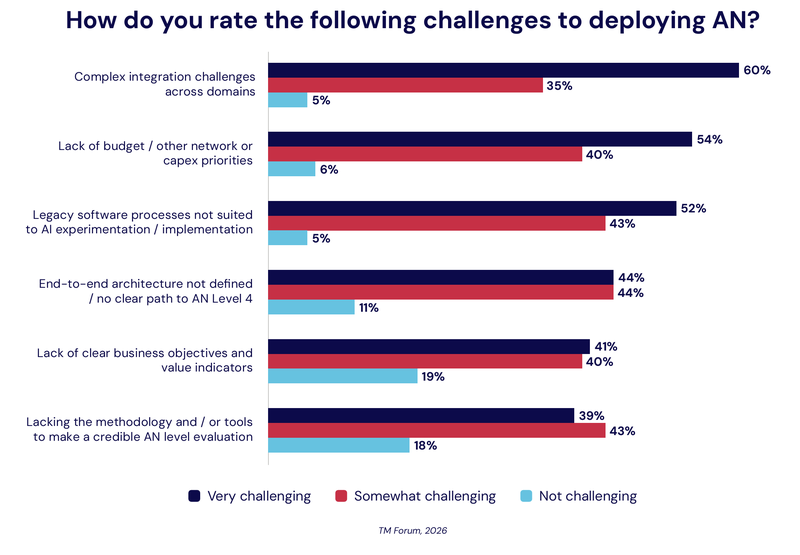
The complex integration challenge posed by cross-domain automation is the biggest We asked respondents how they rate various challenges to deploying autonomous networks. obstacle, rated as very challenging by 60% of respondents and somewhat challenging by a further 35%. Two key factors contribute to this: the vast number of legacy systems that most CSPs still have throughout all network domains, which creates integration complexity; and a legacy cultural mindset.
Lack of budget / other capex or network priorities was rated as very challenging to more than half of respondents, possibly due to those CSPs being in a phase of capex-intensive network deployment. It is hard to prioritize automating a network if it is still being built. However, it may also suggest that the inherent value (and potential savings) created by AN acceleration is not universally understood or valued enough.
More than half of respondents cited the fact that their legacy software processes are not suited to AI experimentation and implementation. But upgrading software platforms and processing capability to provide a foundation for AI is a very necessary investment if CSPs are to pursue increasingly sophisticated uses of AI as a tool for disruptive transformation. Legacy and technical debt dramatically slow the evolution of CSP business and are the enemies of growth and ability to exploit the full power of AI. To support their transformation, CSPs must pivot traditional IT management to a composable, AI-native model.
Another 44% of respondents said the lack of a clear end-to-end architecture or path towards Level 4 AN is very challenging, the same number that found it somewhat challenging. But efforts to clarify the pathway to Level 4 AN are accelerating. TM Forum and its Members have produced an autonomous networks Level 4 Blueprint to help CSPs, and a growing number have now achieved Level 4 for specific high-value scenario use cases.
AN deployment challenges less highly rated by respondents included lack of AI / AN skills (very challenging to 36% of respondents), key technologies lacking maturity (33%) and lack of scaled AN use cases (32%). While there is still work to do on addressing these challenges, the survey results suggest barriers to AN acceleration are being lowered. More employees are being upskilled in AI knowledge and training, which in turn drives AI adoption and more experimentation with / trialing of potential use cases for AN.
The importance of data
To be viable, intents must be grounded in data: observed, measured and controlled intents with which to drive the autonomous system, and verifiable under dynamically changeable conditions. But while CSPs have vast volumes of data, it typically resides in domain-specific silos, so understanding what data is required, where it resides and how it can be pulled together is another challenge.
Establishing a data culture is critical. A strong data foundation, based on data quality and multi-domain data is critical to AN success. “
"A strong data foundation is fundamental to intelligent operations. It underpins our whole analytics and automation strategy,” Olivier Simon, SVP Smart Network & Data, Orange Innovation Group, told us in an interview for this report. “For example, network performance is accessible to marketing employees as an automated data model, and customer complaint data can be referenced by network engineers. We refer to this as a ‘data democracy’ of multi-domain data sharing.”
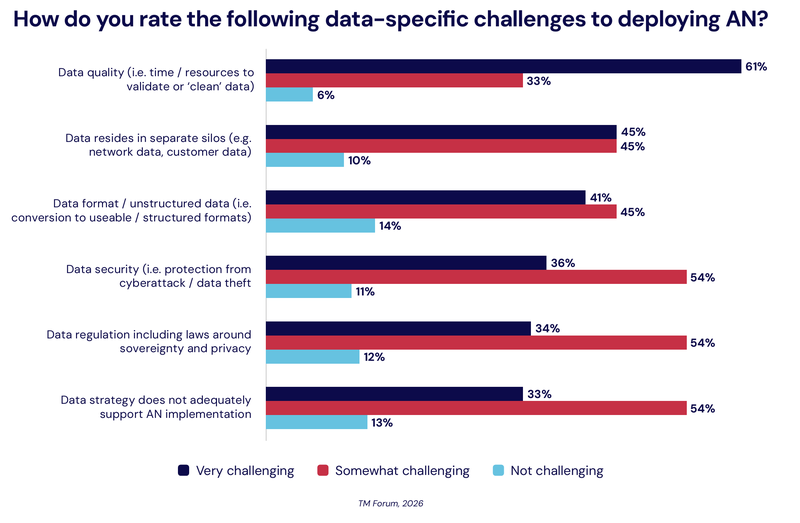
To manage network and service operational processes, data must be accurate and easily accessible. To this end, we asked our survey participants how they rate data-specific challenges to deploying autonomous networks.
Data quality was the highest rated data-specific challenge to AN deployment (very challenging for 61% of respondents). Data quality is critical for AI because it directly dictates model accuracy, reliability and ethical principles. High-quality, representative data enables models to learn accurate patterns and generalize well, while poor data causes biased, incorrect or unreliable outputs. Data residing in separate silos was the next highest data-specific challenge to AN deployment, rated very challenging by 45% of respondents and somewhat challenging by the same percentage. Siloed data adds complexity to cross-domain integration and can lead to incomplete or unreconciled data sets.
Data security, regulation and lack of strategy to support AN implementation were all considered very challenging to one third of respondents.
Measuring the benefits
TM Forum’s vision for autonomous, next-generation services is for CSPs to be able to deliver zero-wait, zero-touch and zero-trouble experiences for consumers and businesses through intelligent infrastructure and AI-enabled operations. A critical part of this is being able to measure the effectiveness of improvements made, in terms of impact on customers and internal efficiencies.
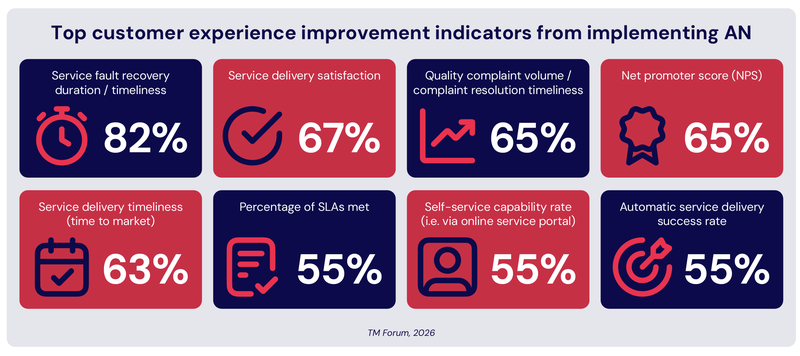
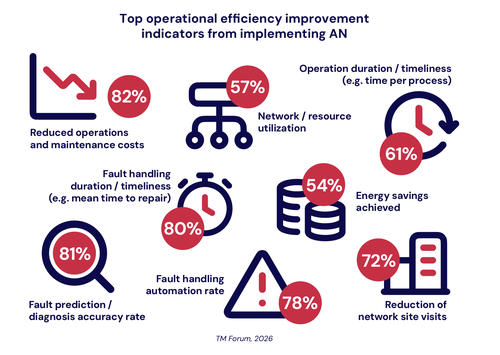
We asked respondents how they measure improvements resulting from the implementation of AN capabilities, both from CX and operational perspectives. The metrics chosen to measure performance and efficiency – together with audits, reviews, benchmarks and maturity assessments – are a critical component of process review. This not only allows CSPs to accurately determine how effective processes are and whether they are improving, but the measurement result can also be organized to provide meaningful insights.
For example, if a team wants to improve the mean time for fault resolution to reduce customer complaints, it can compare results in different services to identify the differentiation. The identification of value effectiveness should be from the perspective of all stakeholders.
One performance metric can have multiple values, such as mean time to resolve (MTTR) in call centers. From the perspective of operations, MTTR is a reduction in workload; from the perspective of managers, it is an improvement in efficiency and user satisfaction; and from the perspective of end-users, it is a reduction in waiting time for problem solving.
As examples of how these metrics are manifesting as measurable benefits of AN adoption, TM Forum CEO Nik Willetts referenced some notable CSP successes in his keynote address at Innovate Asia 2025:
- China Mobile is saving 6,000 hours of employee work per year as a consequence of efforts to transform its network autonomy
- DNB (Malaysia) has cut network MTTR by 54%
- Telstra has achieved 30% faster time to market and 20% opex reduction in 5G network slicing.
A whitepaper published by TM Forum in 2025 details AN-related benefit metrics cited by CSPs, including:
- From a trial in east Indonesia of AI-driven predictive network operations, Telkomsel has reduced wireless traffic loss by 12.6%, improved MTTR by 6%, and increased its CEI (customer experience index) by 14.7%.
- Through advancements in AI-based fault propagation and part of its network automation transformation, IOH (Indonesia) has achieved a 33% reduction in network trouble ticketing and a 10% customer complaint reduction
- Implementation of closed-loop automation / zero-touch provisioning of its voice over wi-fi / LTE services, has enabled Pakistan-based CSP Jazz to achieve a 40% reduction in dropped calls with 55% of its voice service incidents being resolved automatically.
CSPs need value metrics and measurement methodologies to apply to specific AN-impacted service areas and use cases, so that they can benchmark operational values and relate these to customer experience.
Such indicators give operators clarity about the progress of autonomous capability, identify areas requiring improvement, and guide capital and resource allocation for digital service development. “We believe if we cannot measure we cannot improve,” Bat-Erdene Gidaagaaya, CTO of Unitel Mongolia, told us in an interview.
Because Unitel has adopted service quality and network performance monitoring, this drives more accurate data capture when the company’s customers report problems. These become insights into user behavior and help power higher levels of automation and complaint resolution, says Gidaagaaya.
Integrating AI into AN
CSPs cannot achieve Level 4 AN without implementing agentic AI. An evolution of traditional and generative AI, AI agents apply proactive, multi-step reasoning to design, execute and optimize workflows and then independently make decisions and execute them.
Agentic AI can analyze situations and identify the optimal paths for action and continuous selfimprovement with little or no human intervention. It can also support customer management, enabling virtual assistants to evolve beyond pre-rehearsed responses to prompts to act autonomously based on customer requests.
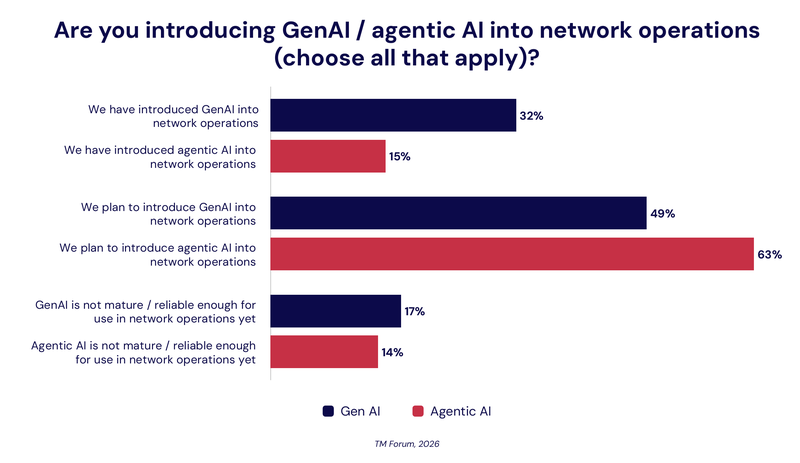
With that in mind, we asked survey respondents whether they are introducing GenAI / agentic AI into network operations. Given the relative newness of generative and agentic AI, it is perhaps no surprise that most respondents are still in the planning to implement stage for both. What is surprising is that almost one third have already introduced GenAI into network operations. This percentage is quite high, given that use cases are still evolving and proof points of success have not emerged to a critical mass within the industry. It is likely indicative of growing confidence in GenAI and its applicability as a tool for network operations transformation.