Member Insights
Control, trust and governance are needed to reach AN Level 4
Tupl’s David Palacios explains why reaching the highest levels of network autonomy requires focusing on system design.
 David Palacios

Control, trust and governance are needed to reach AN Level 4
While many telecoms operators have publicly committed to reaching Level 4 autonomous networks, the operational reality tells a different story. Most operators sit between Level 2 and Level 3: Automation exists but is fragmented across network domains and still relies on human supervision for validation and escalation. Closed-loop capabilities remain domain-specific, with pilots that don’t scale.
The bottleneck is control, trust and governance, not technology. The operators that are achieving the highest levels of autonomy treat it as a system design problem.
What changes between levels
Per TM Forum’s AN Framework, Level 2 to Level 3 moves systems from assisted automation, where humans execute decisions, to partial autonomy, where systems act within predefined scopes but still need human validation for high-impact changes. Level 3 to Level 4 is the real inflection, when systems detect, decide and act autonomously across domain boundaries, and human oversight moves from approving individual actions to defining policies, boundaries and escalation logic. Higher AN levels mean autonomous decisioning under constraints, taken by validated logic governed before it reaches the network, not by a probabilistic model deciding live.
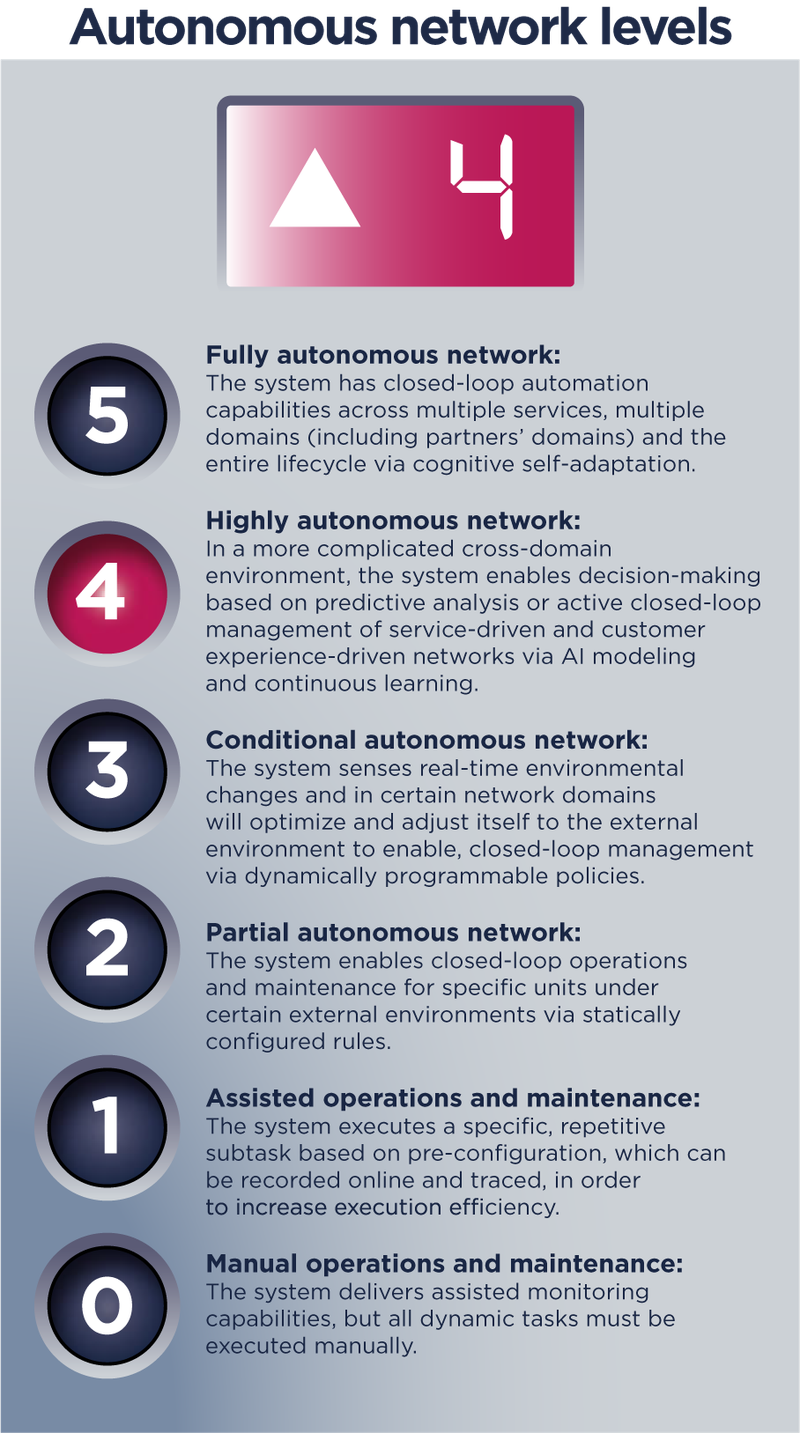
As operators push toward Level 4, the question shifts from “Can we automate this?” to “Can we trust the system to act safely?”. TM Forum’s Autonomous Networks Operator Perspectives report cites three recurring concerns: loss of visibility into decisions; unpredictable AI-driven behavior; and exposure to service level agreement (SLA) breaches or regulatory liability when autonomous actions go wrong.
The common failure pattern is black-box AI paired with uncontrolled scripts that have direct system access and no rollback path. When these systems hit edge cases, the only recovery is emergency manual intervention, erasing the automation’s value.
Control makes autonomy scalable
A well-designed AN architecture separates intelligence, orchestration and execution into distinct layers, each with a defined scope of authority:
- Intelligence, where generative and agentic AI operate, analyzes, investigates and proposes new automation logic.
- Orchestration validates and approves it before it runs.
- Execution runs only approved, deterministic logic within pre-approved parameters.
What reaches the network is a governed artifact, not a live AI decision. Every closed loop needs validation before action, policy enforcement during execution and rollback if outcomes deviate.
Humans don’t approve every action at higher AN levels. Based on TM Forum’s human-in-command model, they define the policy space, escalation thresholds and rollback conditions, and approve the logic allowed to run inside it. The system then executes without interruption.
AI stays active in operations, separated by path, not phase. Agents investigate and propose but never act on the network directly. Where no validated logic applies, the system escalates instead of improvising, and the confirmed resolution becomes a new governed pattern.
Multi-domain closed loops: the missing link
Most automation today is domain-specific: a RAN optimization loop here, a core fault management workflow there. These can’t address service degradation that originates across domains.
At Level 4, the system correlates signals across radio access, core and transport networks and the service layer, coordinating remediation across domains instead of applying isolated local fixes. TM Forum’s AN Framework guidelines call this cross-domain intent: expressing outcomes rather than issuing domain-specific commands, then letting orchestration translate those outcomes into coordinated action.
Data, trust and explainability
Advancing AN maturity requires data maturity too. Real-time telemetry, consistent data models and reliable pipelines are prerequisites for trustworthy decisioning.
But data quality alone doesn’t earn trust. Operators reject AI they can’t explain, and regulators increasingly require auditability for automated decisions affecting critical infrastructure. TM Forum’s AI Governance Framework calls for explainable workflows, human-readable execution logs and decision rationale surfaced without requiring operators to interpret model internals.
Operators making consistent progress follow a staged model:
- Start with rule-based automation in low-risk workflows, building governance and rollback in from the start.
- Introduce closed-loop workflows in bounded domains with reliable telemetry, validating performance before expanding scope.
- Add predictive intelligence to anticipate degradation and act before impact occurs.
- Introduce agentic AI selectively, to investigate and propose logic that enters production only through governance.
- Scale across domains once single-domain loops are proven, on a foundation of demonstrated reliability.
The governing principle is start small, prove impact, scale safely. Operators who reach sustained Level 4 report significant reductions in mean time to repair (MTTR), lower incident volume and higher touchless resolution rates.
Autonomy without control is not autonomy
The industry has no shortage of AI tools. Operators that scale autonomy build architectural discipline into the system from the start, with governance frameworks, explainable decisioning, human-defined policy boundaries, deliberate placement of non-determinism and closed loops that recover gracefully from the unexpected.
TM Forum’s AN Framework provides the milestones. Reaching them is a system design challenge, requiring staged deployment and human-machine collaboration that doesn’t diminish as autonomy increases.